

The Shift from Static to Dynamic Ink
Redefining the male tattoo as a living entity.
“Do not design for the body you have today. Design for the body you will inhabit tomorrow.”
The Philosophy of the Living Canvas
Dynamic Ink is a design philosophy that anticipates change. It accepts that the human body is a landscape in constant flux. Muscles will grow and atrophy; skin will stretch and contract; scars will form. A “Future-Proof” tattoo is designed to ride these waves rather than be drowned by them. It utilizes negative space not just for contrast, but as “breathing room” for the ink to expand over decades without turning into an illegible blob.
This approach also changes why men get tattooed. We are moving away from purely decorative art toward “Functional Identity.” This means the tattoo serves a psychological or narrative function. It might map a specific muscle group to enhance the visual impact of gym gains, or it might encode personal data—like the soundwave of a child’s laugh or a coordinate of a life-changing event—into a pattern that looks like abstract art to the stranger, but holds deep data for the wearer.
The Three Pillars of Dynamic Ink
- Fluidity: Designs that flow with muscle fibers rather than fighting against them.
- Longevity: Styles specifically chosen because they “season” well, looking better with age like worn leather.
- Resonance: Imagery that connects to your internal narrative, ensuring you don’t outgrow the meaning even if your tastes change.
In this comprehensive guide, we will dismantle the standard catalog of “cool tattoos for men” and rebuild it from the ground up. We will explore how to visualize your own biometrics, how to use UV ink for hidden layers, and how to place tattoos to hack your own psychology. Welcome to the future of skin.
Designing for the 4th Dimension
Understanding how time alters the canvas.
The Science of the Blur
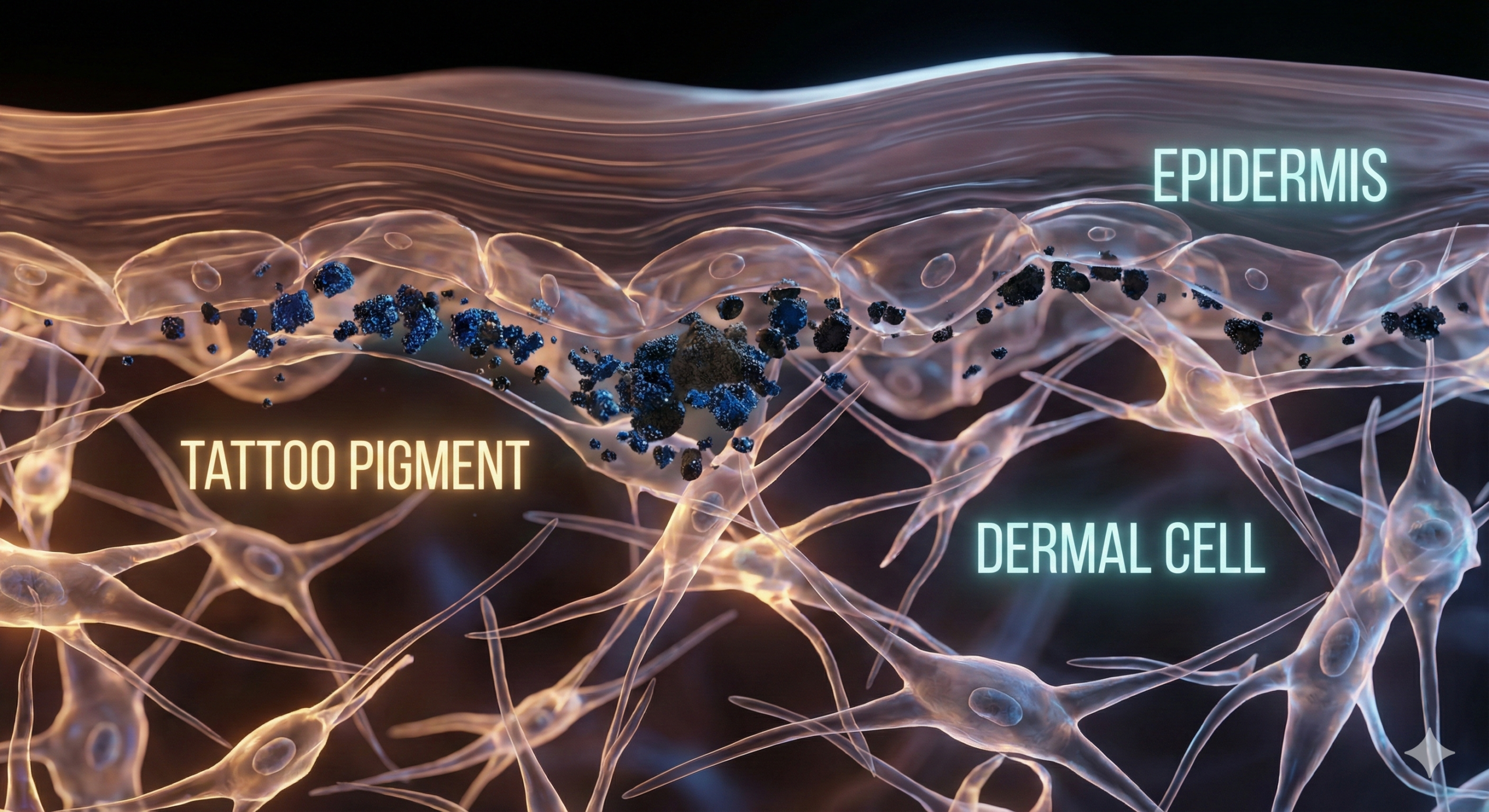
When tattoo needles puncture the skin, they deposit pigment into the dermis. Your immune system immediately identifies this ink as a foreign invader. Macrophages (white blood cells) rush to the site and engulf the ink particles to remove them. However, the pigment particles are often too large for the cells to carry away, so the macrophages essentially “choke” on the ink and freeze in place. This is what makes a tattoo permanent: a suspended war between your immune system and the pigment.
Over decades, however, these macrophages die and are replaced by new ones. During this hand-off, tiny amounts of ink migrate. This is why all tattoos eventually blur. Dermatological studies suggest that lines can expand by up to 1-2mm over a lifetime. While this sounds small, in a micro-realistic portrait where the eyes are only 3mm wide, that migration destroys the image.
Future-Proofing Strategies
To combat this, we use a technique called “Bold-Will-Hold” Architecture. This doesn’t mean you are limited to thick, American Traditional lines, but it does mean you must prioritize structure over detail.
| Design Element | Aging Risk | The Future-Proof Solution |
|---|---|---|
| Micro-Text | Becomes unreadable blobs. | Use minimal sizing (12pt+) or negative space lettering. |
| White Ink | Turns yellow/beige due to melanin. | Use skin breaks (negative space) for highlights instead. |
| Tight Realism | Los details; faces look “melted.” | High-contrast “Illustrative Realism” with defined borders. |
The “Patina” Effect
The smartest men choose styles that look better as they age. Consider the Blackwork or Sacred Geometry styles. As these lines soften, they don’t lose their definition; they simply look more organic, as if they were grown rather than drawn. This is the “Patina” effect—similar to how raw denim or high-quality leather develops character over time.
When consulting with your artist, ask them to perform the “Squint Test.” If they squint at the design and it becomes unrecognizable, it is too detailed. If the main shapes remain readable even when blurred, you have a design that will survive the 4th Dimension. In the next block, we will explore how to turn your personal biological data into one of these lasting designs.
Bio-Data Aesthetics
Visualizing your inner algorithm through generative design.
“A lion tattoo says you admire strength. A soundwave tattoo of your father’s advice says you carry his voice. The former is decoration; the latter is a relic.”
Types of Data-Driven Ink
Here are three cutting-edge ways to convert your life into art:
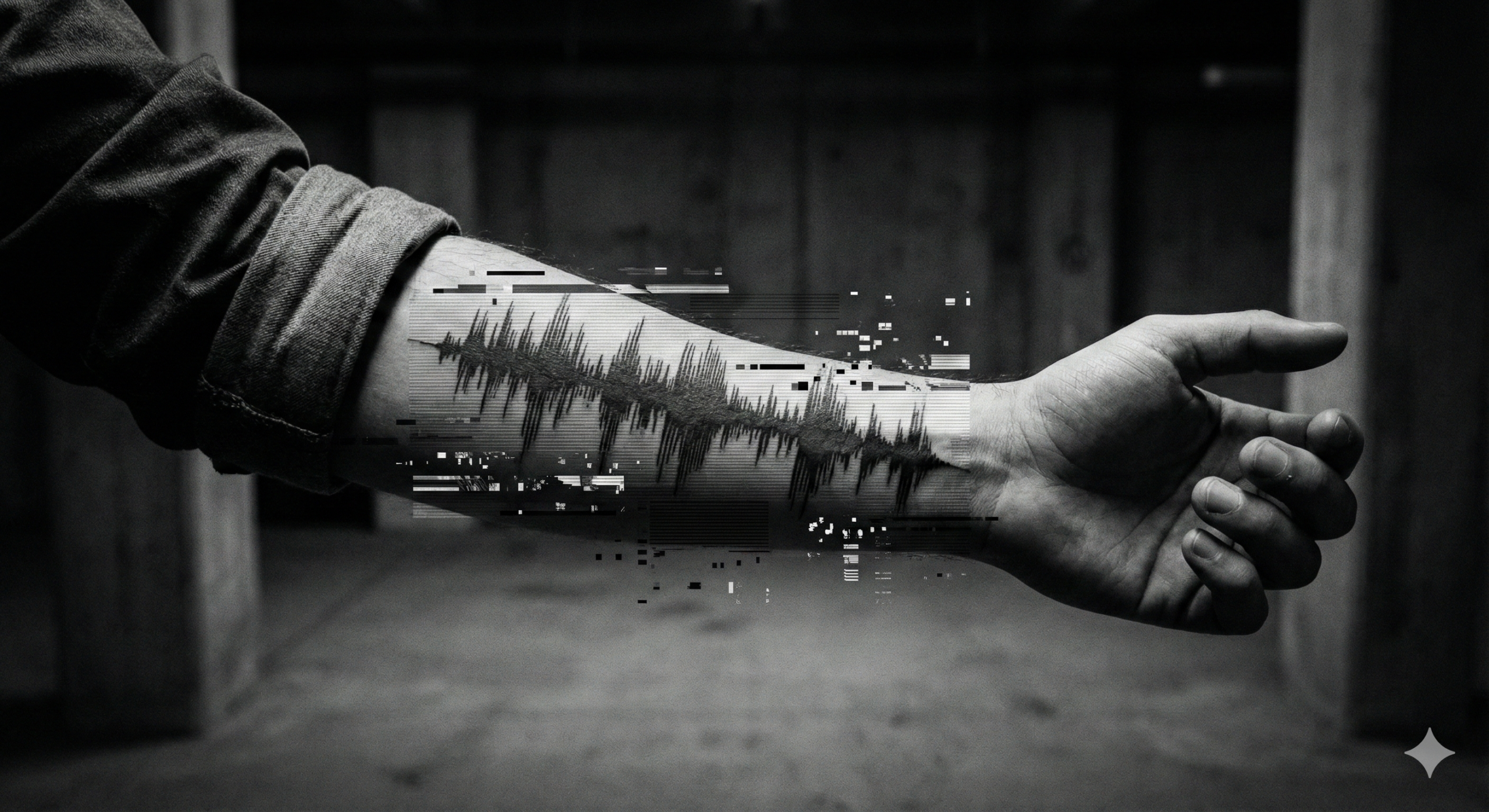
- The Audio-Visualizer (Soundwaves): Instead of writing a name or a quote, you take the audio waveform of a loved one saying it. Artists can wrap this waveform around a limb like a bracelet. It looks like abstract spikes and valleys to the naked eye, but you know it’s the exact frequency of a specific moment. Some augmented reality apps can even scan these tattoos and play the audio back.
- Coordinate Geometry (Poly-Lines): Rather than a realistic map, consider “Poly-Line” maps. Take the GPS coordinates of three pivotal locations in your life (birthplace, where you met your partner, where you achieved a major success). Connect these points on a global scale to create a geometric triangle or polygon. This shape becomes your personal sigil—a minimalist geometric shape derived from your life’s geography.
- Glitch Art & Distortion: Life is rarely perfect; it is full of static and noise. Trash Polka and Glitch styles embrace this. Imagine a classic portrait of a Greek statue, but “sliced” digitally, with pixels dragging off the edge. This represents the intersection of history and the digital error, perfect for men in tech or creative fields.
The Hidden Binary
For a subtler approach, consider binary or morse code embedded into larger designs. A “dotwork” fade (stippling) is usually random. However, a skilled artist can arrange the dots to actually spell out a message in binary code within the shading of a larger piece. It creates a “layer 2” of meaning—a secret message hidden in plain sight, accessible only to those who know the code.
Bio-Data Aesthetics shifts the conversation from “What picture do I want?” to “What data defines me?” It turns the body into a localized server of your most precious memories.
Anatomical Flow & Muscle Mapping
The art of Kinetic Ink: Designs that move when you do.
The Zones of Kinetic Potential
| Zone | The Anatomy | The Design Strategy |
|---|---|---|
| The Deltoid Shield | A rounded, triangular muscle cap. | Designs should be “Pauldrons” or armor plating. Circular mandalas work here only if they drape over the curve to accentuate the shoulder cap. |
| The Forearm Twist | Muscles that twist the radius/ulna bones. | Spiral designs or snakes that wrap around the arm. As you rotate your wrist, the design should “coil” and “uncoil.” |
| The Trapezius Flow | The slope from neck to shoulder. | High-flow scripts or wings. Avoid rigid squares here. The ink must flow down and out to widen the visual frame of the shoulders. |
The “reveal” Mechanics
One of the most creative applications of Kinetic Ink is the “Reveal.” This utilizes the folding of joints (inner elbow, back of the knee, or armpit) to hide or change the tattoo.
- The Morphing Jaw: A tattoo of a skull placed on the hand, and the lower jaw placed on the thumb. When the hand is open, the mouth is open; when a fist is made, the jaw shuts tight.
- The Expansion Gap: Accordion-style geometric patterns placed on the elbow. When the arm is straight, the pattern is condensed. When the elbow bends, the skin stretches, and the pattern “breathes” or expands, revealing secondary colors hidden in the creases.
Bio-Mechanical vs. Bio-Organic
When mapping anatomy, you generally have two aesthetic choices: Bio-Mechanical (replacing muscles with gears and pistons) or Bio-Organic (replacing muscles with alien textures, roots, or coral). Both styles rely entirely on flow. The artist draws directly on the skin with markers (freehand) rather than using a stencil, ensuring the “implants” line up perfectly with your unique tendon insertion points. This makes the tattoo feel like it is inside you, exposed by a tear in the skin, rather than sitting on top of it.

The Palette of the Future
Beyond black and grey: Exploring UV, conductive, and “smart” pigments.
UV and Blacklight Reactive Ink: The “Shadow Self”
UV ink is perhaps the most immediately accessible “future-tech” for men. These inks are practically invisible in standard daylight but glow intensely under blacklight. They are notoriously difficult to work with, requiring a specialized artist.
The Strategy: Use UV ink to layer a “Shadow Self” narrative over an existing visible tattoo. For example, a standard blackwork portrait of a stoic lion in daylight could, under UV light, reveal a glowing, snarling skull beneath its skin. It represents the duality of man: the composed exterior and the primal interior. It is a secret you carry, revealed only in specific environments (nightlife, intimate settings). Note: Always verify the safety data sheets of UV inks with your artist, as regulations vary.
The Frontier: Conductive & Bio-Sensitive Inks
This is the bleeding edge, where body art meets the cyborg. While still largely in research and development phases, scientists at institutions like MIT have been developing “smart inks.”
- Biosensors: Imagine tattoo ink that changes color based on your body chemistry. Inks that shift from green to red when your glucose levels spike or your hydration drops. This turns the tattoo into a permanent, passive health monitor.
- Conductive Circuits: Inks laced with conductive metals that can essentially turn your skin into a circuit board. While currently mostly aesthetic (looking like gold or silver circuitry traces), the near future may see these linking with wearable tech, allowing you to control devices with a tap on your forearm tattoo.
Ephemeral Ink: Strategic Impermanence
Commitment is often cited as the main barrier to getting tattooed. Enter “Ephemeral Ink.” These are specially designed pigments engineered to break down naturally within the body over a set period—usually 1-3 years—unlike traditional ink trapped by macrophages (as discussed in Block 2).
Why would a man want a temporary tattoo? Proof of Concept. It allows you to “beta test” a massive piece, like a full sleeve or neck tattoo, to see how it affects your professional life and self-image before committing to the permanent version. It’s a strategic tool for the cautious architect of his own body.
Psychosomatic Placement
Hacking your psychology by placing symbols on specific body zones.
Visual Anchors: Programming Yourself
Visual Anchors are placed in your high-frequency line of sight. Their purpose is self-regulation, motivation, or grounding. You see them dozens of times a day, reinforcing a mental state.
- The Inner Forearm/Wrist: The prime spot for “memos to self.” This is where you place mantras, reminders of mortality (Memento Mori), or symbols of patience. When you are stressed in a meeting and look down at your hands, this tattoo should reset your mental state.
- The Finger/Knuckle: High visibility, high impact. Often used for commitments (like wedding ring replacements) or core values like “HOLD FAST.” Because hands are agents of action, tattoos here represent agency and control.
External Signals vs. The Hidden Arsenal
Some tattoos are armor meant to be seen; others are reactors powering you from beneath the surface.
| Placement Zone | Psychological Association | Best Use Case |
|---|---|---|
| Chest/Over Heart | Vulnerability, Core Values, Protection. | Family crests, names of children, or spiritual guardians. Things you would “take a bullet for.” |
| The Back (Full Canvas) | The Past, The Foundation, The Burden carried. | Massive narratives or epic scenes. You rarely see it; others see it when you walk away. It is your history backing you up. |
| Calves/Legs | Stability, Grounding, Forward Motion. | Heavy geometric patterns or roots. Designs that visually “weigh you down” to the earth, providing a solid base. |
Wardrobe Armor
Consider the “suit reveal.” A full Japanese bodysuit (Horimono) traditionally stops at the collarbones and wrists, remaining completely hidden under business attire. This creates a powerful psychological dichotomy: the civilized professional on the outside, the untamed warrior underneath. This “hidden arsenal” approach allows you to control the narrative, revealing your true colors only when you decide the situation warrants it.
The Narrative Scar
From camouflage to Kintsugi: Turning trauma into architectural features.
Topographical Integration
Scars have texture—keloids are raised, atrophic scars are sunken. A master artist uses this 3D texture as part of the design.
- The Ridge Line: A long surgical scar down the spine or knee can be transformed into the “spine” of a biomechanical creature or the stem of a dark botanical piece. The raised tissue adds a tactile reality that flat ink cannot achieve.
- The Void: For sunken or jagged scars, the “Blast-Over” technique allows the scar to remain ink-free (negative space) while heavy blackwork surrounds it. This creates a high-contrast window, turning the scar into a lightning bolt of white skin cutting through the darkness.
The Blast-Over: Reclaiming Territory
Sometimes, the “trauma” isn’t physical, but aesthetic—a regretful tattoo from your youth. Laser removal is painful and expensive. The modern solution is the Blast-Over. Unlike a “Cover-Up” (which tries to hide the old tattoo with a darker block of ink), a Blast-Over places a bold, open design on top of the old faded one.
The old tattoo is still visible underneath, acting as a chaotic, textured background layer. It acknowledges your history: “I was that person, but now I am this person.” It creates a layered visual effect, like graffiti on an old wall, adding depth and grunge that a fresh tattoo lacks.
Ancestral-Futurism
Neo-Tribalism and Cyber-Sigilism: The intersection of ancient history and sci-fi.
The Cyber-Sigilism Aesthetic
Characterized by sharp, aggressive, fine lines that look like thorns, wire, or lightning, Cyber-Sigilism is designed for the slim or athletic build. It emphasizes verticality and speed.
| Traditional Tribal | Ancestral-Futurism (Modern) |
|---|---|
| Thick, blunt shapes (Bio-Organic). | Razor-sharp, fine lines (Bio-Digital). |
| Static placement (Armband). | Dynamic flow (runs from neck to fingers). |
| Cultural Appropriation risks. | Mathematically generated, culture-neutral. |
Algorithm as Ritual
This style appeals to men in STEM, coding, and architecture. It visualizes the unseen networks that run our world. By using fractal geometry, these tattoos mimic the repetitive patterns found in nature (ferns, crystals) and technology (motherboards). It connects the wearer to the “machine spirit,” creating an armor that feels both ancient and alien.
Maintenance 2.0
The tattoo doesn’t end at the shop. Bio-hacking skin for maximum longevity.
The Enemy: UV Radiation
The sun is a laser that shatters pigment. UV rays penetrate the skin and break down the ink molecules into smaller particles, which the immune system then flushes away. This is fading.
The Protocol: If you are heavily tattooed, you are no longer just “using sunscreen.” You are maintaining an investment. Use physical barriers (SPF clothing) or high-zinc oxide sunscreens (SPF 50+) specifically on ink. A tanned arm makes black ink look grey/blue. Pale skin makes black ink look like obsidian.
Collagen and Hydration: The internal Canvas
Your skin needs structure to hold the ink in place. As you age, collagen breaks down, leading to sagging and “ink drift.”
“Think of your skin as the glass over a museum painting. You must keep the glass clean and uncracked.”
- Hydration: Dry skin turns white and ashy, placing a “foggy filter” over your tattoo. Daily moisturizing is non-negotiable.
- Exfoliation: Dead skin cells pile up on the surface, dulling the brightness. Gentle exfoliation once a week removes this layer, instantly making an old tattoo look 20% brighter.
- Supplements: Consider collagen peptides and Vitamin C to maintain skin elasticity, keeping lines sharp well into your 50s and 60s.
The Living Legacy
Final thoughts on becoming a work of art.
The Curator of Self
Stop looking for “cool designs” on social media. Start looking inward. Look at your biometrics, your history, your anatomy.
The future-proof man understands that a tattoo is not an accessory; it is a modification. It creates a Chrono-Somatic Interface—a visual language that speaks of who you were, who you are, and who you intend to become.
So, go forth. Find an artist who understands anatomy, not just tracing. Design for the 4th dimension. Wear your story on your skin, and let the ink age with you, like wine, like leather, like a life well-lived.